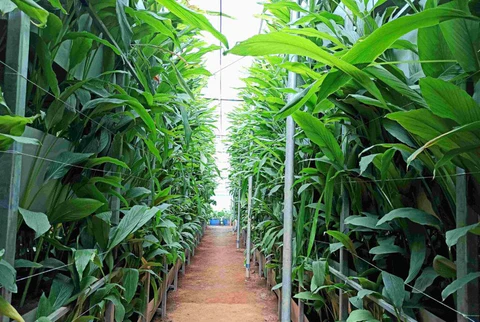
1. Importance of Moisture Regulation in Turmeric Cultivation
Turmeric is highly sensitive to soil moisture conditions due to its underground rhizome-based growth habit. While adequate moisture is essential for vegetative growth and rhizome bulking, excess or poorly drained water is the primary cause of yield loss and quality degradation in turmeric cultivation.
For Lakadong turmeric, excessive moisture stress not only increases the risk of rhizome rot but also disrupts physiological processes linked to curcumin biosynthesis. Moisture regulation is therefore a central pillar of protected turmeric cultivation.
________________________________________
2. Root-Zone Physiology and Water Sensitivity
Turmeric roots are shallow and fibrous, functioning primarily as absorptive organs rather than deep anchoring systems. The rhizome itself is highly metabolically active and requires adequate oxygen availability for healthy growth.
Prolonged saturation of the root zone leads to:
● Reduced oxygen diffusion
● Anaerobic conditions around rhizomes
● Suppressed enzyme activity
● Increased susceptibility to soil-borne pathogens
Lakadong turmeric, with its dense rhizome tissue and high metabolic flux, is particularly vulnerable to such stress.
________________________________________
3. Advantages of Drip Irrigation under Polyhouse Conditions
Drip irrigation is the preferred irrigation method for Lakadong turmeric under polyhouse cultivation due to its precision and controllability.
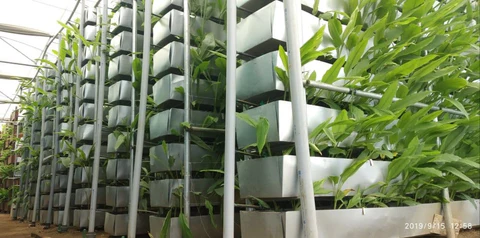
Key benefits include:
● Uniform moisture distribution in raised beds
● Reduced waterlogging risk
● Improved nutrient uptake efficiency
● Lower disease incidence compared to flood irrigation
Drip systems also allow integration with fertigation, enabling simultaneous control of water and nutrient supply.
________________________________________
4. Stage-Wise Irrigation Requirements
Irrigation demand in turmeric varies across growth stages:
● Establishment phase:
Light but frequent irrigation to support sprouting and root initiation without saturating the rhizome zone.
● Vegetative growth phase:
Moderate irrigation aligned with canopy development and evapotranspiration demand.
● Rhizome bulking phase:
Carefully regulated irrigation to support biomass accumulation while avoiding excess moisture.
● Maturation phase:
Gradual reduction in irrigation to promote rhizome hardening and reduce disease risk prior to harvest.
Polyhouse cultivation enables these adjustments with far greater accuracy than open-field systems.
________________________________________
5. Water Productivity and Efficiency Gains
Water productivity—measured as yield or quality output per unit of water used—is a critical metric for evaluating sustainability and profitability. Polyhouse-based drip irrigation systems typically achieve significantly higher water productivity than open-field turmeric cultivation.
Improved water productivity results from:
● Reduced evaporation losses
● Targeted root-zone wetting
● Elimination of rainfall-induced excess moisture
● Lower crop losses due to rot and disease
For Lakadong turmeric, higher water productivity translates directly into higher quality yield rather than increased volume alone.
________________________________________
6. Moisture Control as a Disease Management Tool
Many major turmeric diseases, particularly rhizome rot, are closely linked to excess moisture and poor drainage. Effective irrigation management therefore functions as a preventive disease control strategy rather than a reactive intervention.
Polyhouse cultivation allows growers to:
● Decouple irrigation from rainfall
● Maintain consistently aerated root zones
● Reduce reliance on chemical disease control measures
This aligns with residue-free production objectives for premium turmeric markets.
________________________________________
7. Strategic Implications for Lakadong Turmeric Production
From a strategic perspective, irrigation precision enables Lakadong turmeric to be cultivated as a quality-driven crop rather than a climate-dependent commodity. Controlled moisture management preserves the genetic and biochemical advantages of Lakadong germplasm while reducing production risk.
________________________________________
8. Lead-in to the Next Section
This section has established irrigation and moisture control as decisive factors in Lakadong turmeric cultivation under polyhouse conditions. The next part focuses on pest, disease, and soil biology management, completing the core agronomic risk-management framework.
________________________________________
🔗 Continued in PART 9
Pest, Disease, and Soil Biology Management in Lakadong Turmeric under Polyhouse