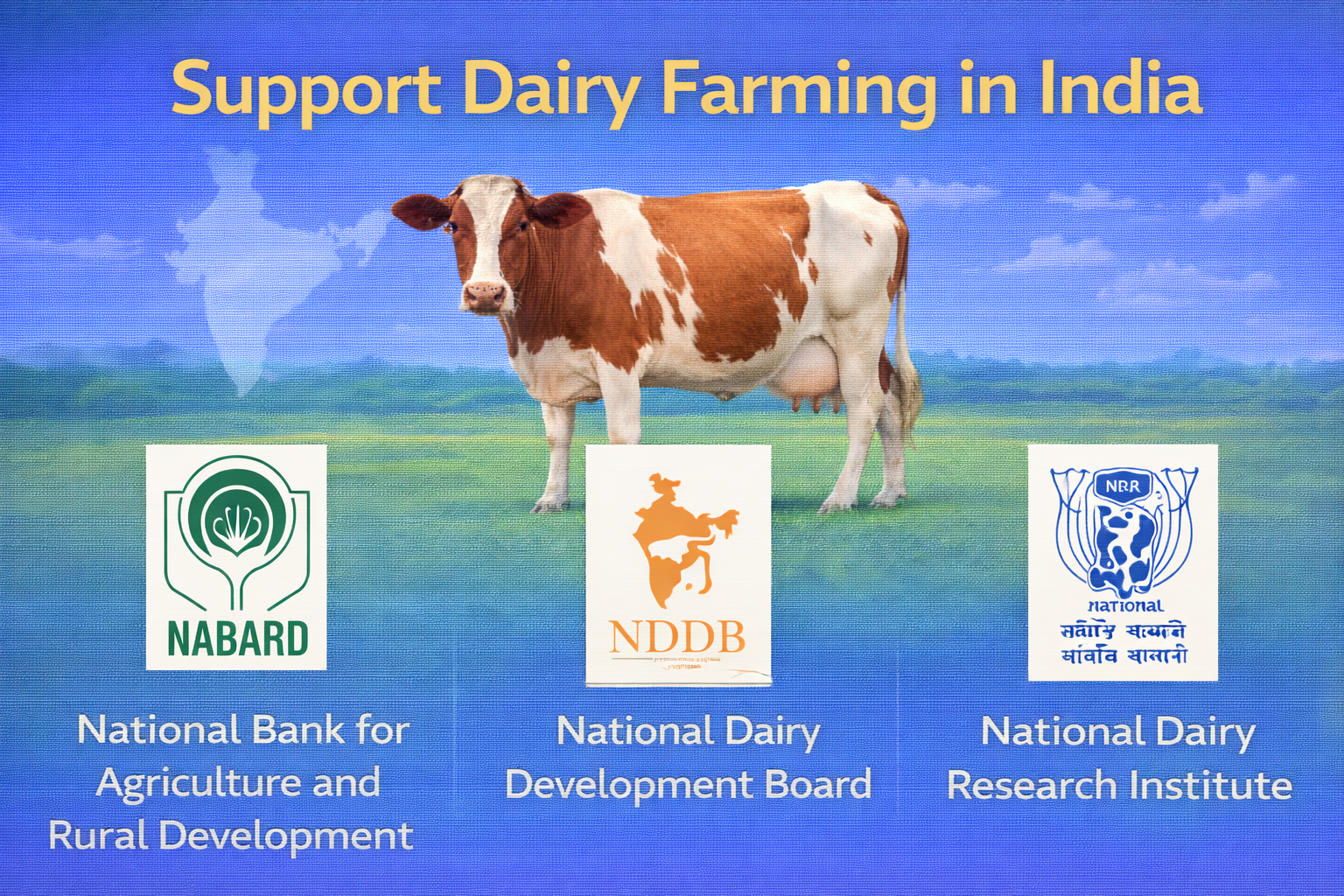
1. Role of Government in Dairy Development
The government’s role in dairy farming is largely enabling rather than operational. Policies aim to reduce entry barriers, stabilize farmer income, and improve long-term productivity rather than manage farms directly.
Primary policy objectives
● Improve milk productivity per animal
● Strengthen rural livelihoods
● Reduce disease and mortality risks
● Encourage organized dairy infrastructure
2. Central Government Schemes for Dairy Farming
2.1 Department of Animal Husbandry & Dairying (DAHD)
DAHD functions under the Ministry of Fisheries, Animal Husbandry and Dairying and acts as the nodal body for dairy-related policies.
Key focus areas
● Animal health programs
● Breed improvement initiatives
● Dairy infrastructure support
● Farmer capacity building
2.2 National Dairy Development Programmes (NDDB-linked)
Many national dairy initiatives are implemented with technical support from National Dairy Development Board.
Typical objectives
● Strengthening milk cooperatives
● Improving milk procurement systems
● Enhancing processing capacity
2.3 Dairy Infrastructure Development Initiatives
These schemes aim to support:
● Milk chilling units
● Processing plants
● Value-added product infrastructure
Support mechanisms
● Credit-linked subsidies
● Interest subvention (where applicable)
● Infrastructure grants in selected regions
3. Animal Health & Breeding Support Schemes
Animal health schemes focus on risk reduction, which directly improves farm economics.
Common components
● Free or subsidized vaccination programs
● Disease surveillance and control
● Artificial insemination support
● Breed improvement initiatives
Strategic benefit
Preventive health support often delivers higher returns than direct subsidies.
4. Dairy Animal Insurance Schemes
Livestock insurance schemes are designed to protect farmers from sudden animal loss due to disease, accidents, or natural calamities.
General features
● Partial premium subsidy
● Coverage for productive animals
● Mandatory tagging and identification
Limitations
● Claim settlement delays
● Documentation requirements
● Valuation disputes
5. State Government Dairy Schemes
In addition to central schemes, state governments operate region-specific dairy programs.
Typical state-level focus
● Milk procurement incentives
● Free fodder or mineral mixture distribution
● Interest subsidies for dairy loans
● Breed-specific promotion programs
Implementation quality varies significantly by state.
6. Credit, Loans & NABARD Support
National Bank for Agriculture and Rural Development (NABARD) supports dairy through refinancing and development programs.
Key roles
● Refinancing dairy loans
● Supporting cooperative institutions
● Capacity-building initiatives
Banks remain the primary interface for credit-linked schemes.
7. Practical Challenges in Scheme Utilization
Despite policy intent, many farmers face challenges accessing benefits.
Common issues
● Complex paperwork
● Delayed approvals
● Lack of local awareness
● Mismatch between scheme design and farm reality
Practical insight
Schemes should be viewed as support tools, not as the foundation of a dairy business plan.
Conclusion: Policy Support Complements, It Does Not Replace Discipline
Government schemes play an important supporting role in Indian dairying by reducing risk and encouraging infrastructure development. However, long-term dairy success depends on biological management, economic discipline, and market alignment. Schemes should be treated as supplementary tools rather than primary drivers of decision-making. Informed farmers who understand both policy intent and practical limitations are best positioned to benefit responsibly.
Final Disclaimer (Mandatory)
The information presented in this chapter is intended solely for general awareness and educational reference. Government schemes, subsidies, incentives, eligibility criteria, financial assistance limits, and implementation guidelines related to dairy farming in India are subject to frequent change based on central and state government policies, budget allocations, administrative orders, and local interpretations.
Actual availability and benefits of any scheme depend on:
● State and district-level implementation
● Year-wise budget provisions
● Bank and departmental approvals
● Individual farmer eligibility and documentation
Readers are strongly advised to verify all scheme details directly with:
● Local Department of Animal Husbandry offices
● State dairy development authorities
● Banks and financial institutions
● Official government portals and notifications
Seechur Agro, its editorial team, and contributors do not provide any assurance or guarantee regarding the availability, approval, quantum, or continuity of any government scheme mentioned in this chapter. This content should not be treated as financial, legal, or policy advice, nor should it be used as the sole basis for making investment or operational decisions in dairy farming.